
What Teachers Should Know About AI Bias

AI is quickly becoming an integrated technology within P-12 classrooms. From lesson planning and grading assistance to tutoring chatbots that provide immediate feedback, generative and predictive AI technologies offer greater efficiency, personalization, and support for educators and learners. When used intentionally and thoughtfully, AI programs can be powerful and transformational. But as they become more embedded in teaching and learning, educators must be aware and vigilant of algorithmic bias.
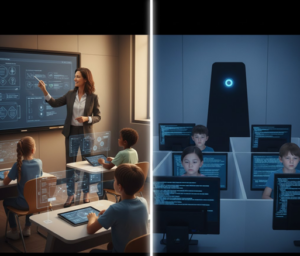 Large language models that power AI tools are not neutral. They are designed and built by humans using human-created data, and are directly shaped by the values, assumptions, and limitations embedded in that data. When teachers rely solely on AI without critical oversight, they risk amplifying biases that can result in negative rather than positive learning gains.
AI models learn predictable patterns from large, internet-based datasets. One of the most concerning and perpetuated myths about AI is that it is objective. Because algorithms rely on data and mathematical models, their quick responses and outputs can appear authoritative or unbiased. In reality, AI reflects the patterns it has learned, and depending on the end user, these patterns can prefer and prioritize one set of information or viewpoint over another.
When teachers defer too readily to AI-generated responses, their professional judgment can be unintentionally skewed. Over time, this can erode balanced and responsive teaching practices and reduce students to discrete data points rather than whole learners.
Proceeding cautiously does not mean rebuffing AI altogether. It means using AI as a tool, not a definitive authority.
To create this needed balance, educators can take the following sensible actions:
• Question AI outputs: Determine what ideas are represented and which are missing.
• Cross-check outputs: Compare responses among different AI programs.
• Teach students about AI bias: Enable students to become critical consumers of technology.
Most importantly, teachers should focus on human judgment, relational knowledge, and ethical responsibility, which AI cannot replace.
AI will continue to be a part of teaching and learning processes, whether educators engage critically or not. The question is not whether AI belongs in classrooms, but how it is used and who is accountable for ensuring it is used ethically, intentionally, and responsibly. Teachers are not merely end users of technology; they are ethical gatekeepers of students’ learning experiences. Proceeding with caution means slowing down, asking hard questions, and refusing to outsource professional judgment and discernment to an algorithm. In a moment of rapid technological change, critical thinking and thoughtful skepticism may be among the most important skills educators can model for themselves and their students.

Rebecca Blankenship
About the Author
Rebecca J. Blankenship is an award-winning educator and researcher with over 25 years of teaching experience. Her current research examines the ecologies of meanings as a systems-based, hermeneutic approach to ethics in AI and gen-AI teaching and learning modalities. She is currently an Associate Professor in the College of Education at Florida Agricultural and Mechanical University.