Beyond One-Size-Fits-All

Educational institutions, corporations, government agencies, and training organizations are being asked to respond to technological change at an unprecedented pace. Generative artificial intelligence is reshaping curriculum, assessment, workforce development, and organizational strategy. Accessibility expectations are becoming more rigorous. Learners are demanding flexible, relevant, and engaging educational experiences.
At the same time, leaders must determine how to fund, govern, and scale innovation without losing sight of institutional mission, instructional quality, or human connection.
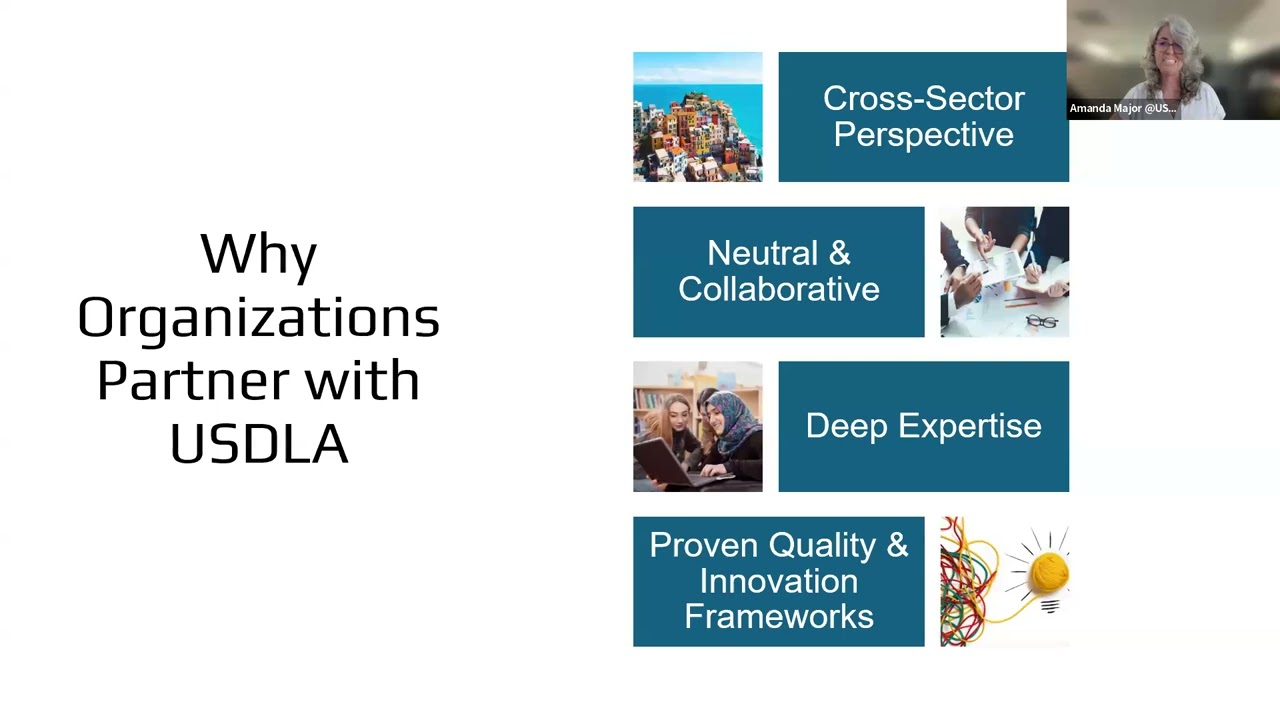
To help organizations navigate these challenges, USDLA’s Amanda Major, Chuck Sengstock, and Bill Ryan held a special session on July 24 exploring “Strategic Digital Learning Consulting and Credentialing Opportunities”.
The session examined how customized consulting, organizational assessment, program certification, and credentialing can help institutions respond to emerging technologies, changing learner expectations, accessibility requirements, and evolving workforce needs.
[View the replay of the July 24 Certification and Consulting Webinar](https://www.youtube.
The conversation also highlighted an important principle: standardized solutions are rarely enough.
The United States Distance Learning Association provides customized digital learning consulting and certification services designed to help organizations understand where they are, define where they want to go, and develop a practical path forward.
Rather than applying a single model to every organization, USDLA approaches each engagement as a collaborative partnership grounded in institutional context, stakeholder perspectives, organizational data, and measurable goals.
Digital Learning Is an Institutional System
A successful digital learning strategy cannot be developed in isolation. Technology may support the work, but technology alone does not create a healthy learning environment.
USDLA views an institution as an interconnected system built around four essential areas: leadership, academic affairs, learner affairs, and teaching and learning.
Leadership
Presidents, vice presidents, boards, and executive leaders establish the mission, vision, priorities, and resources that guide digital learning. Their decisions influence whether innovation remains a small pilot project or becomes an integrated institutional strategy.
Academic Affairs
Deans, department chairs, program directors, and academic leaders help determine how new technologies and learning models fit within curriculum, accreditation, assessment, faculty expectations, and academic policy.
Learner Affairs
Admissions, advising, financial aid, accessibility services, career services, and other student-support areas shape the learner experience beyond the classroom.
Even a strong academic program can struggle when students encounter barriers in enrollment, financing, navigation, accessibility, or support.
Teaching and Learning
Faculty, instructional designers, trainers, and learners are at the center of educational delivery. Their experiences provide essential insight into whether courses, technologies, assessments, and support structures are effective in practice.
These four areas must work together. A breakdown in one part of the system can undermine progress elsewhere. For example, an innovative online program may offer excellent instruction but still experience low enrollment or poor retention when admissions processes, financial-aid systems, or learner-support services are difficult to navigate. USDLA’s holistic approach helps organizations identify these connections and build strategies that align leadership, academic priorities, learner services, and instructional practice.
The Challenges Facing Digital Learning Leaders
Organizations are under pressure to innovate while managing financial, operational, ethical, academic, and reputational risks. Many leaders know that change is necessary but feel overwhelmed by the number of decisions involved. Several challenges frequently emerge during consulting conversations.
Funding and Resource Allocation
Digital transformation involves more than purchasing software. Organizations must consider staffing, training, accessibility, cybersecurity, instructional design, assessment, governance, maintenance, and long-term support.
Artificial intelligence introduces additional hidden costs. Institutions may need new data protections, professional development, policy review, platform evaluation, technical integration, and quality-assurance processes.
A strategic review can help leaders distinguish among essential investments, underused existing resources, and technologies that may not align with institutional priorities.
The Rapid Pace of Technology
Generative AI demonstrates how quickly technology can disrupt established practices. Within a relatively short period, organizations have had to reconsider academic integrity, assessment design, employee training, content production, student support, data privacy, and curriculum relevance. The challenge is not simply deciding whether to use AI. Organizations must determine where it adds value, where limitations or risks exist, and how human expertise will remain central to decision-making.
Changing Risks
In the earlier stages of online learning, institutional risk often centered on access. Could students log in? Did they have the necessary technology? Was the learning management system functioning? Those concerns remain important, but the risk environment has expanded.
Organizations must now address questions such as:
* Is digital content accurate and trustworthy?
* Can learners distinguish authentic information from manipulated or fabricated material?
* Are assessments secure, meaningful, and aligned with learning outcomes?
* Is learner data being protected?
* Are automated decisions being reviewed by qualified people?
* Are digital resources accessible to individuals with disabilities?
These issues require coordinated governance rather than isolated technical fixes.
Evolving Learner Expectations
Learners increasingly expect educational experiences to be flexible, accessible, career-relevant, and responsive to their needs. They may engage with content differently than learners did only a few years ago. Institutions must therefore examine not only what they teach, but also how learners discover programs, access support, demonstrate achievement, and connect learning to professional or personal goals.
Preserving the Human in the Loop
Automation and AI can strengthen performance support, streamline processes, and expand access to information. However, efficiency should not eliminate professional judgment, ethical oversight, or meaningful human interaction.
A central question for organizations is not simply, “What can we automate?”
It is, “Where must human expertise, empathy, accountability, and decision-making remain visible?”
USDLA helps organizations consider this question as part of a broader digital learning strategy.
Strategic Areas of Growing Importance
Although every consulting engagement is different, several areas are generating significant institutional interest.
Artificial Intelligence Readiness
AI readiness begins before an organization writes a policy or purchases a new tool. Leaders must first understand the institution’s current relationship with AI. Stakeholders may be enthusiastic, concerned, resistant, uncertain, or already experimenting independently. These perspectives affect whether a future strategy will be accepted and implemented successfully.
An AI-readiness assessment may explore:
* Current AI use across departments
* Institutional attitudes and concerns
* Existing policies and governance structures
* Faculty and staff knowledge
* Learner expectations
* Data privacy and security
* Academic integrity
* Curriculum integration
* Accessibility
* Human oversight
* Professional-development needs
From this foundation, USDLA can help organizations develop governance recommendations, implementation priorities, and tactical roadmaps that reflect their mission and level of readiness. The goal is not to adopt AI simply because it is available. The goal is to determine where AI can support learning and organizational performance while preserving transparency, accountability, and human judgment.
Accessibility as Strategy
Digital accessibility is both a compliance responsibility and an opportunity to improve learning. Institutions are preparing for expanded accessibility requirements affecting websites, documents, course materials, media, and other forward-facing digital resources. Meeting these expectations requires more than a one-time review. Accessibility must be incorporated into procurement, instructional design, content development, faculty support, technology selection, and quality assurance.
When accessibility is treated as part of good design, everyone benefits.Clear navigation, readable documents, captions, transcripts, alternative text, flexible formats, and well-structured content can improve the experience of learners, faculty, staff, and members of the public.
USDLA helps organizations examine accessibility across the institutional system so that responsibility does not rest with only one department or individual.
Micro-Credentials and Digital Badging
Micro-credentials and digital badges offer institutions new ways to recognize skills, respond to workforce needs, and create flexible pathways into academic programs. However, launching a badge or short-term credential does not guarantee demand. Successful micro-credential strategies require careful consideration of:
* Employer and workforce needs
* Market demand
* Learner populations
* Credential value and recognition
* Academic quality
* Assessment practices
* Pricing and sustainability
* Marketing and recruitment
* Technology platforms
* Stackability into certificates or degrees
* Alignment with existing institutional programs
USDLA helps institutions move beyond a “build it and they will come” approach. Consulting may begin with a market review, workforce analysis, or institutional-readiness assessment before moving into program design and implementation. The strongest models identify the intersection among learner demand, employer need, institutional expertise, and sustainable academic pathways.
A Collaborative Consulting Process
USDLA consulting is built around listening, partnership, customization, and practical implementation. Although each engagement is different, the process often includes four core phases.
1. Listening to Stakeholders
The process begins by engaging the people who experience the organization from different perspectives. These stakeholders may include executive leaders, faculty, instructional designers, student-support professionals, technology teams, learners, employers, community partners, and board members.
Stakeholder listening helps uncover challenges that may not appear in formal reports. It can also reveal existing strengths, successful local practices, and platforms or resources that are not being used to their full potential.
2. Defining Success
Before recommending solutions, USDLA works with the organization to clarify what success should look like. Success may involve:
* Improving learner retention
* Expanding access
* Increasing enrollment
* Strengthening instructional quality
* Developing AI governance
* Meeting accessibility expectations
* Launching workforce-aligned credentials
* Improving faculty support
* Scaling an effective pilot program
* Strengthening coordination among departments
Qualitative and quantitative measures are then identified so progress can be evaluated over time.
3. Assessment and Benchmarking
USDLA reviews internal data, practices, policies, platforms, and stakeholder knowledge to establish the organization’s current position. Benchmarking may also compare institutional practices with peers, competitors, professional standards, or emerging trends. The objective is not to imitate another institution. It is to understand the broader environment and identify realistic opportunities for improvement.
4. Actionable Deliverables
Consulting must lead to action.
Depending on the engagement, deliverables may include:
* Strategic recommendations
* Tactical implementation roadmaps
* Governance models
* Policy guidance
* Professional-development schedules
* Instructional-support plans
* Accessibility priorities
* AI-readiness frameworks
* Micro-credential strategies
* Fiscal-year implementation plans
* Academic-calendar-based timelines
* Quality-assurance processes
* Metrics and evaluation plans
Recommendations are designed to reflect the organization’s actual resources, culture, mission, and capacity for change.
Different Challenges Require Different Approaches
A policy-centered engagement may require a very different process from a program-development initiative. For example, an AI-policy engagement may begin by examining institutional attitudes, existing practices, governance gaps, and readiness for adoption. The resulting work may focus on policy recommendations, ethical guidance, oversight structures, professional development, remediation, and a phased implementation roadmap. A micro-credential engagement may begin with market demand, workforce alignment, institutional appetite, and existing academic offerings.
Its long-term focus may include program implementation, learner recruitment, credential stackability, employer recognition, enrollment growth, and institutional scaling. Both engagements require strategic thinking, but the questions, stakeholders, evidence, and measures of success will differ. This distinction reflects a central USDLA principle: the consulting process must match the organization’s specific challenge rather than forcing the challenge into a predetermined model.
Experience Across Institutional Sectors
USDLA has provided consulting, review, and certification services to a diverse range of institutions and educational organizations. Its experience includes work with public universities, private institutions, historically Black colleges and universities, specialized colleges, and community-college systems.
Institutions associated with USDLA consulting and certification efforts have included:
* University of Central Florida
* University of Wisconsin–Stout
* Morgan State University
* Bethune-Cookman University
* Berkeley College
* Central State University
* Landmark College
* Kentucky Community and Technical College System
This range of experience demonstrates the flexibility of USDLA’s model. A large public university, a specialized institution serving neurodiverse learners, an HBCU, and a community-college system may share broad digital learning goals. Still, their missions, learners, structures, resources, and implementation needs are not identical. Their strategies should not be identical either.
From Certification to Continuous Improvement
Certification can provide valuable external recognition, but the most meaningful review processes also support reflection, learning, and continuous improvement. USDLA’s evolving approach recognizes that organizations may need more than a checklist or final designation. They may need support interpreting evidence, building consensus, aligning departments, addressing gaps, and moving from recommendations to implementation.
Consulting and certification can therefore work together as parts of a broader improvement process. Assessment establishes a clearer understanding of current performance. Consulting helps transform findings into strategic priorities. Implementation planning turns those priorities into action. The result is not simply recognition of where an organization stands today. It is a clearer pathway toward where the organization wants to go next.
Building Digital Learning with Fidelity
Effective innovation requires fidelity to mission, learners, evidence, and organizational context. It is tempting to respond to technological change by purchasing the newest platform, copying a peer institution, or launching a highly visible initiative. However, sustainable progress often begins with a more fundamental set of questions:
* What problem are we trying to solve?
* Who is affected by it?
* What does our internal data tell us?
* What resources do we already have?
* Which platforms are underused?
* What level of change can our organization support?
* How will we know whether the strategy is working?
* Where must human oversight remain central?
USDLA helps organizations explore these questions without assuming that one answer will fit every institution. In a period of rapid technological and educational change, organizations do not need another generic solution. They need a trusted partner that can help them connect vision with evidence, innovation with responsibility, and strategy with implementation. Through customized consulting, institutional assessment, certification, and credentialing opportunities, USDLA supports organizations in building digital learning systems that are accessible, sustainable, responsive, and prepared for what comes next.
Watch the Webinar and Learn More
To hear more about USDLA’s strategic approach, watch Amanda Major, Chuck Sengstock, and Bill Ryan’s July 24 session on **Strategic Digital Learning Consulting and Credentialing Opportunities.
[Watch the Certification and Consulting Webinar replay](https://www.youtube.
Organizations interested in strengthening their digital learning programs, exploring program certification, or developing a customized consulting engagement can find additional information through USDLA.
[Learn more about USDLA Program Certification & Consulting](https://usdla.org/