
Implications for Distance Learning when AI Transitions to SI

AI has been transforming distance learning through personalized instruction, automated feedback, and expanded access to educational resources. But what happens when AI advances toward superintelligence (SI)—machine intelligence that could eventually surpass human cognitive abilities across a broad range of domains?
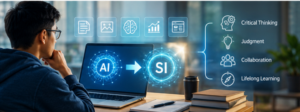 Although superintelligence remains prospective, its potential implications deserve serious attention. Distance educators must prepare for a future in which machines may not simply assist instructors but outperform humans on many cognitive tasks.
Superintelligence could revolutionize online education through sophisticated simulations, adaptive learning pathways, and instructional support available on a scale not currently realized by AI. However, delivering information is not the same as developing a deeper, more nuanced understanding. A machine might generate an excellent research paper, solve a complex problem, or design an effective lesson without ensuring that a student possesses the knowledge and judgment to perform those tasks independently. As machine capabilities increase, educators must distinguish between what technology can accomplish and what learners must be able to accomplish themselves.
As super intelligent systems assume more refined instructional capabilities, educators must focus on learning design, intellectual mentorship, authentic assessment, and helping students evaluate machine-generated information.
Faculty development must extend beyond learning how to operate AI tools. Educators need strategies to evaluate automated recommendations, preserve meaningful student engagement, and determine whether learners demonstrate genuine competence independent of the machine. The goal is not to reject the AI-to-SI advancement but to ensure that technology strengthens rather than replaces human intellectual development.
When AI can produce sophisticated assignments, evaluating only final products may no longer reliably demonstrate student learning. Distance educators should incorporate oral explanations, practical demonstrations, reflective analysis, and authentic problem-solving activities. Students must demonstrate not only what they can produce with technological assistance but also how they reason, justify their decisions, and apply their knowledge to a range of scenarios and situations.
Institutions must also establish policies addressing privacy, transparency, bias, and accountability. Greater machine capability does not automatically make machine-created decisions educationally appropriate.
Three priorities can help institutions prepare:
1. Redesign learning experiences. Evaluate technology according to intentional and meaningful learning outcomes rather than efficiency alone.
2. Preserve intellectual independence. Teach students to verify information, challenge recommendations, and accept responsibility for their conclusions.
3. Establish responsible governance. Define boundaries for automation and maintain appropriate human oversight of consequential educational decisions.
The transition from AI to SI presents extraordinary opportunities alongside significant challenges. Progressively intelligent systems could expand access to expertise and transform instructional possibilities. They could also make it easier to confuse sophisticated technological output with genuine human understanding.
The future depends on how educators and institutions navigate this distinction.
The ultimate measure of educational innovation is not how intelligently a machine performs, but how effectively learning develops human knowledge, judgment, and responsibility.
As distance learning enters an era of increasingly adaptable and capable machines, its greatest challenge will be ensuring that technological advancement continues to serve the fundamental purpose of education: helping people transform into more capable, independent, and thoughtful learners.