
Trust is Relational; Not Technological

Creating learning environments built on trust has always been foundational to an effective education. To enable long-term cognitive development, learners must trust that educators are guiding them toward meaningful learning. Conversely, educators must trust that learners are engaging actively and honestly with the learning process. Learning institutions must trust that assessments and key assignments reflect authentic achievement and student learning gains. Society then trusts that graduates possess the knowledge and skills their educational credentials represent.
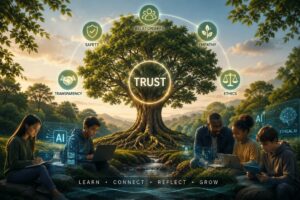 The rapid adoption of AI in traditional human-to-human learning spaces is reshaping each of these conventional relationships.
While much of the conversation surrounding AI in education has focused on academic integrity, detection tools, and institutional policies, they often structure trust as something that must be intentionally monitored or actively enforced. However, perceiving trust as an ecology is more productive – it should be regarded as a dynamic network of relationships that must be purposely nurtured if AI is to strengthen rather than weaken learning.
As AI becomes a more consistent presence in traditional educational spaces, the challenge is not simply trusting the technology. It is learning how to preserve and develop long-lasting trust among educators, learners, and institutions.
Trust Is Relational, Not Technological
Trust cannot be programmed into any technological system. Trust emerges from interpersonal relationships and shared experiences.
Learners need confidence that AI-scaffolded experiences are designed to help them cognitively transform their work rather than simply systematize it. Educators need assurances that AI enhances, rather than diminishes, their professional expertise. Institutions need policies that encourage creativity and innovation while maintaining high academic standards. Employers need confidence that graduates can think critically and solve problems independently, rather than merely generate polished responses using AI.
These forms of trust are ecologically interconnected. Weakness in one relationship can have a profoundly negative effect on the entire learning ecosystem.
Human Judgment Remains the Anchor
One of AI’s greatest strengths is its ability to generate plausible, human-like responses through natural language processing. Yet plausibility is not the same as accuracy, and confidence is not the same as knowledge.
The defining characteristic of educated individuals has never been the ability to retrieve information alone. It is the application of a cognitively sophisticated skill set to critically evaluate evidence, interpret context, recognize uncertainty, and make sound judgments.
These are distinctly human abilities that technology cannot imitate.
AI can accelerate analysis, identify patterns, and offer multiple perspectives, but it cannot assume responsibility for ethical decisions, professional accountability, or the consequences of human action.
The Future of Distance Learning Depends on Trust
Distance learning has always relied on trust. Unlike traditional human-to-human learning environments, educators often cannot observe every moment of learning, even during synchronous sessions. Success depends on thoughtfully designed experiences that encourage engagement, integrity, and meaningful interaction.
AI does not change this reality.
It amplifies it.
The institutions that thrive in the coming decade will not be those with the most sophisticated AI tools. They will be those who intentionally cultivate cultures of trust in which technology supports learning, educators exercise thoughtful leadership, and learners develop the judgment to use AI wisely and ethically.
Trust, then, is not a barrier to innovation.
It is the condition that makes innovation reliable and sustainable.
As AI continues to reshape traditional education, it must be contended that the strongest learning ecosystems are not built on algorithms. They are built on relationships, accountability, and the shared commitment to helping learners to transform into thoughtful, capable, and trustworthy professionals.
That is the ecology of trust—and it will determine not only how we use AI, but how learners are prepared to flourish in an increasingly intelligent world.

Rebecca Blankenship
About the Author
Rebecca J. Blankenship is an award-winning educator and researcher with over 25 years of teaching experience. Her current research examines the ecologies of meanings as a systems-based, hermeneutic approach to ethics in AI and gen-AI teaching and learning modalities. She is currently an Associate Professor in the College of Education at Florida Agricultural and Mechanical University.