
How AI Changes the Traditional Learning Ecosystem

Implementing AI into traditional learning spaces often focuses on its practical applications. While these capabilities are impressive, they overlook a more important question: How does AI change the traditional learning ecosystem?
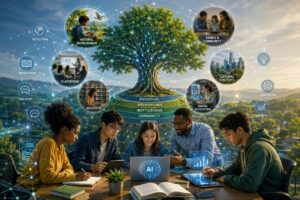 Teaching and learning are uniquely human endeavors that cannot occur in isolation. Learners do not interact with content in a static way; they actively engage with teachers, peers, families, institutions, technologies, and society. AI is another entity layered within this complex ecosystem, influencing not only how learning happens but also how learners think, communicate, and make meaning. Thus, AI’s educational impact must be considered not just as a tool, but as part of the ecology of learning.
Learning Is an Ecosystem
Educational psychologist Urie Bronfenbrenner described human cognitive development as occurring within nested ecological systems in which learners are continuously influenced by interconnected environments. Initially developed to explain child development, ecological systems thinking provides a valuable lens for understanding AI in education.
Every learner operates within a dynamic network of interconnected relationships:
• Classroom interactions with instructors and peers
o Learners use AI before asking teachers questions or for assistance. Teachers redesign assignments around AI-assisted tasks and feedback.
• Institutional policies
o Regarding the ethical uses of AI in assessment and key assignment creation.
• Professional and workplace expectations
o Employers increasingly expect graduates to work alongside intelligent systems.
• Cultural values and societal influences
• Personal experiences, beliefs, and motivations
o Public discourse shapes perceptions about whether AI represents opportunity, risk, or both.
None of these systems operates independently, continuously interacting to create an evolving educational ecosystem.
Designing Healthy Learning Ecologies
Healthy ecosystems depend on balance. An ecosystem dominated by a single species becomes fragile. Likewise, learning environments become less effective when AI replaces too much of the human interaction that supports intellectual growth.
Consider the relationships that matter most in education. AI should strengthen these relationships—not replace them:
• Instructor and learner
• Learner and learner
• Learner and authentic problems
• Learner and self-reflection
• Learner and community
When learners use AI to create ideas before collaborative discussions, classroom conversations often have more depth. When faculty use AI to provide preliminary feedback, they have more time for personalized instruction. When instructional designers use AI to improve accessibility, more learners can participate fully and reach their learning potential.
Looking Ahead
The future of distance learning is not defined by AI alone. It is defined by the ecologically layered relationships we build around it.
When AI is viewed as one component within a larger ecology of learning, it extends beyond technology itself to encompass the environments that enable learners to undergo cognitive transformation. The discussion then turns to not just what a learner can accomplish using AI, but also what AI can accomplish, and how it shapes curiosity, collaboration, reflection, and lifelong learning.
The future of education will belong not to the institutions with the most advanced AI, but to those that intentionally cultivate learning ecosystems where technology amplifies humanity rather than overshadows it.
In the end, the most important intelligence in education will always be the wisdom to design learning environments where people—and the technologies they use—can thrive together.

Rebecca Blankenship
About the Author
Rebecca J. Blankenship is an award-winning educator and researcher with over 25 years of teaching experience. Her current research examines the ecologies of meanings as a systems-based, hermeneutic approach to ethics in AI and gen-AI teaching and learning modalities. She is currently an Associate Professor in the College of Education at Florida Agricultural and Mechanical University.