
When More Technology Means Less Learning

For more than two decades, education has evolved around a central premise: If technology makes learning more accessible, then learning will improve. However, in 2026 as more school districts are limiting or removing access to common technologies during the school day, that premise deserves another look.
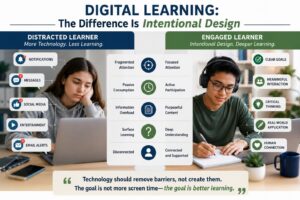 Teachers and learners have access to more digital tools than ever, including learning management systems, mobile devices, streaming lectures, interactive textbooks, discussion boards, digital assessments, and countless educational platforms. Educators are increasingly concerned that accessibility and connectedness are not translating to actual engagement and the realization of learning outcomes. While digital learning removes barriers, convenience can also create disconnection and fragmentation.
Current research increasingly relates effective self-regulated learning practices, such as goal setting, time management, and managing the learning environment, with reduced digital distraction. The problem may not be technology, but how learning is designed to be effective and responsive when learners’ attention is competing with multiple resources simultaneously.
Thus, course design and instruction do not become innovative or relevant simply because they contain more videos, discussion boards, quizzes, or interactive tools. Purposeful considerations must be given to what learners are actually learning with a particular technology. Accordingly, effective digital learning should prioritize meaningful collaboration, reflection, and opportunities for deep thinking. This necessarily means the reduction of discussion boards, instant messaging, social media posts, videos, and the like.
The human element must remain the central consideration in teaching and learning. Learners need educators who recognize when they are struggling. They need meaningful conversations with peers, authentic feedback, and opportunities to connect learning to real-world problems. While technology can and should support these experiences, it should not replace them. The adage then becomes that less technology can positively equate with more learning. Realistically, the future of digitally powered education should in changing the conversation from using more technology to selecting the right technology for the right learning purpose. The goal should not be to keep learners constantly connected but rather to keep them deeply engaged for deeper mean making and transformational learning.

Rebecca Blankenship
About the Author
Rebecca J. Blankenship is an award-winning educator and researcher with over 25 years of teaching experience. Her current research examines the ecologies of meanings as a systems-based, hermeneutic approach to ethics in AI and gen-AI teaching and learning modalities. She is currently an Associate Professor in the College of Education at Florida Agricultural and Mechanical University.