
The Credibility Challenge in Microcredentialing

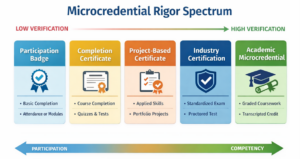 Microcredentials are a rapidly expanding form of educational and industry certification used in both higher education degree programs and workforce training. Marketed as adaptable, skill-based alternatives to traditional degrees and endorsements, microcredentials are increasingly offered by universities, technology companies, professional organizations, and online learning platforms. Despite their growing popularity, there are substantial variations in the criteria for earning these credentials and in the descriptive standards.
A comparative analysis of different microcredential courses and related curricula reveals that credentials with similar titles often differ significantly in rigor, descriptive standards, and in the verification of learning objectives. For instance, certificates in areas such as digital marketing, data analytics, and cybersecurity may require learners to complete coursework ranging from a few hours to several months, along with project-based assessments. Frequently, some credentials are conferred simply for completing training modules, while others require learners to demonstrate competence through portfolio projects, graded assignments or tasks, or proctored certification exams. In some cases, credentialing entities require learners to complete a series of stacked microbadges to earn a final credential.
This lack of uniformity creates challenges for businesses, industries, and educational institutions in determining which criteria to use in credential development. Such considerations could include longevity, marketability, and transferability. From the learner’s perspective, the lack of uniformity makes it difficult to assess the intrinsic value of different microcredentials before investing time and resources, especially if those credentials are not widely recognized. Businesses and industries encounter similar challenges when assessing the validity of credentials on résumés, as identical credential titles issued by different organizations may reflect vastly different skill levels, assessment standards, and completion requirements. For colleges and universities, the lack of consistent standards and transferability makes it difficult to incorporate microcredentials into degree pathways or to recognize them for academic credit.
 These challenges are largely due to inconsistent standards in the current microcredential ecosystem. Credentials are issued by a variety of educational and noneducational entities that lack universal competencies, standardized assessments, or consistent metadata describing expected learning outcomes. As a result, microcredentials are often characterized as ambiguous signals of rote skill mastery rather than reliable markers of authentic competence.
Policy researchers and educational organizations have begun calling for more intentional alignment and calibration in microcredential standards. Some recommended modifications include adopting transparent competency frameworks, normalizing credential metadata to clarify assessment and assignment rigor, and explaining distinctions between completion-based training certificates and competency-based professional certifications. Establishing such structures would improve the credibility, interpretability, and transferability of microcredentials while supporting their integration into both academic and workforce education and training.
Without these restructurings, the continued abundance of microcredentials jeopardizes the creation of an environment in which credential titles operate more as catchy marketing labels rather than as meaningful indicators of verified learning.
Policy Recommendations
1. Standardized Credential Metadata
All microcredentials should include standardized metadata describing:
• learning outcomes
• assessments
• projected workload
• competencies
• rubrics
• credential level (basic to mastery)
2. National or International Competency Frameworks
Professional organizations should actively collaborate to create competency frameworks aligned with educational and workforce needs (ongoing).
3. Credential Level Classifications
Microcredentials should be categorized according to a standardized, rigorous taxonomy. Classifications should also be subjected to validity and reliability measures.
4. Transparent Assessment and Assignment Requirements
Credential providers should disclose the evidence required to demonstrate competence, including:
• exams
• projects
• portfolios
• other tasks
5. Academic Credit Pathways
Policies that encourage articulation agreements between microcredential issuers and colleges/universities would improve credential portability.