
What 2026 Will Require for the Modern Educator

By the end of 2025, most educators reached a similar, quiet realization: technology, especially AI, is no longer an add-on to learning environments. It is now intimately connected to the learning process and embedded in traditional learning modalities.
AI-driven tools now reside within a myriad of existing technology tools that manage learning platforms, shape assessment workflows, support advising, and influence how learners engage with content and receive feedback. Thus, the immediate question as we approach 2026 is no longer Which new technologies should we adopt next? but How do these technologies shape learning such that we stay responsible stewards of their influence on teaching and learning?
It is at this moment that educators must transition their praxis as technology ceases being about efficiency and speed and starts being about ethical use and professional judgment.
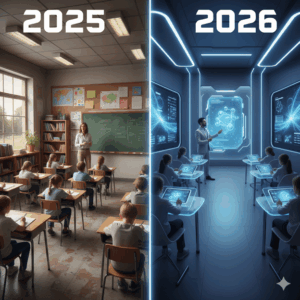 What 2025 Made Clear – AI became an integral part of traditional human-to-human learning environments
In 2025, AI transitioned rapidly from a novel technology with interesting possibilities in educational spaces to an everyday reality of teaching and learning. Educators used it to draft feedback, brainstorm activities, and streamline course design. Learners used it to clarify concepts, practice explanations, and prepare for assessments. These AI-integrations brought notable advantages to traditional teaching and learning, especially in scale and responsiveness. However, rapid AI-integration also introduced a subtle shift: AI now sits between learners and knowledge more often than educators initially realized and accounted for. This is a significant acknowledgement. These generative systems don’t just deliver static, canned information; they reshape how explanations are framed, what constitutes a “good” and reliable answer, and how authority and leadership are perceived in face-to-face and online learning spaces. In other words, AI has evolved into an interpreter of learning, rather than just a peripheral instructional support tool.
Personalization expanded, but complexity somewhat diminished.
Adaptive learning expanded rapidly in traditional and online learning modalities during 2025. These systems, when used well, helped identify learners who needed support sooner, allowing for more flexible instruction. At the same time, many educators have noticed a tension: learning is complex, but data systems tend to prefer simplicity. When progress is reduced to dashboards, quick data points, and risk scores, important humanized context can disappear. The challenge isn’t in the analytics themselves. It is in ensuring that human judgment remains fundamental to interpreting what AI-generated data actually means for real learners.
Digital environments shape meaning, not just access.
Immersive tools, simulations, and AI-facilitated discussions became more common in online courses in 2025. These environments can be powerful, but they also frame what learners notice, question, prioritize, and value. Educators have long known that design choices matter in actual praxis. In 2025, it became clear that technology choices became ethical choices, as they directly influence how learning is experienced and understood.
What to plan for in 2026
1. Leadership will become more intentional, necessary, and thoughtful.
In 2026, effective AI leadership won’t be about long lists of precautionary rules. It will focus on helping educators and learners make informed decisions in real-world contexts.
Strong leadership will result in:
• Understanding when AI supports learning versus when it replaces thinking.
• Understanding where human judgment must remain in actual teaching.
• Understanding how to make system outputs transparent to learners.
For educators, this means building structures that support interpretation, not just compliance.
2. AI literacy will mean more than just how to use a particular tool.
As AI-generated content becomes harder to distinguish from human work, high-quality learning environments and modalities will increasingly focus on facilitating learners in:
• Evaluating sources and explanations.
• Recognizing limitations and bias.
• Reflecting on how tools influence their thinking.
In 2026, AI literacy will primarily focus on learning how to interpret and critically evaluate AI output, rather than simply how to prompt it to illicit a response.
3. Educators must rely on ethical design and professional judgment.
In 2026, educators won’t just teach learners what buttons to click or prompts to write. They will support them in:
• Designing assignments that encourage reflection and reasoning.
• Preserving ethical standards in AI-rich environments.
• Using professional judgment in setting clear expectations for effective learner use.
This reinforces what educators already know about effective praxis; good teaching and related learning outcomes are designed, not automated.
4. Equality will be about meaning and value, not just access.
While access to AI will remain a conversational focus, in 2026, the discussions will go further, prompting educational leaders to ask:
• Whose language and positionalities do AI systems benefit?
• How do analytics impact learners differently?
• Are learners actually being supported or just assigned another label?
Creating AI-equitable learning environments must encompass not only who has access to different programs, but also how meaning is accessed and constructed.
A Final Thought for Educators Entering 2026
2025 marked the year when educational technology, specifically AI, fully integrated itself into traditional teaching and learning systems. In 2026, educators will now have the opportunity to decide how thoughtfully to do it. The next phase is about ensuring that, even at scale, learning remains human-centered, ethically grounded, and intellectually meaningful. While technology can help educators teach more efficiently and productively, it is ultimately their responsibility to use it ethically, prudently, and wisely.

Rebecca Blankenship
Rebecca J. Blankenship is an award-winning educator and researcher with over 25 years of teaching experience. Her current research examines the ecologies of meanings as a systems-based, hermeneutic approach to ethics in AI and gen-AI teaching and learning modalities. She is currently an Associate Professor in the College of Education at Florida Agricultural and Mechanical University.