Why Traditional Literacy Still Matters in the Age of AI

Traditional Literacy Still Matters in the Age of Digital and AI-Mediated Classrooms
Educators and students are increasingly turning to large language models (LLMs), such as ChatGPT, Gemini, and Claude, to critique, summarize, and write text, which are actions that are typically associated with traditional literacy skills. In the digitally mediated age, the human ability to critically read and write lucidly might appear to have been subjugated to digital modalities. However, quite the opposite is true. Traditional literacy skills have become even more relevant in digitally saturated and AI-mediated classrooms. It is not only relevant; it is absolutely essential and foundational to supporting effective digital literacy skills.
 Traditional Literacy Is the Foundation of Digital Literacy
Digital literacy requires a complex set of cognitive and tactile skills that extend beyond just knowing the mechanics of using different technology tools. It is a complex, perceptive cognitive interplay among gathering and analyzing the validity of digital sources, interpreting information from those sources, and then applying deeper meaning to digital texts. These cognitive dexterities are embedded in the same interpretive reading and cogent writing practices that demarcate traditional literacy. A learner who can decipher language, extrapolate meaning, and recognize bias in a print article is much more prepared to evaluate and understand the credibility and validity of an online source or an AI-generated response. Absent this groundwork, digital learning modalities and spaces can become overpowering and ambiguous, where algorithmic bias becomes a substitute for deeper human understanding.
Traditional Reading and Writing Strengthen Digital Critical Thinking
AI LLMs such as ChatGPT, Claude, and Gemini, among others, can broaden a learner’s thought processes, but only when the learner has an existing set of critical thinking skills. Traditional literacy methods such as annotation, close reading, decoding texts, and reflective writing enable learners to be intentionally engaged in critical analysis. This is essential in AI-mediated learning environments where interpretive information is often immediate and can be perceived as authoritative. When learners are literate in the traditional sense, they are better equipped to question, refine, and synthesize generated responses rather than passively accepting them as accurate and true.
Traditional Literacy Builds Metacognition for AI Learning
Effective integration of AI tools in the human-to-human classroom obliges metacognitive awareness. Learners must know how they learn, what they understand, and where they need support. Traditional literacy skills enable this through methods such as recognizing main ideas and self-evaluating comprehension. Learners who engage regularly in traditional, non-digital reading and writing are more self-aware learners who are able to use AI tools more creatively and for deeper inquiry rather than inert cognition. In other words, traditional literacy aids learners to remain the perceptive agents of their own thinking in an AI-mediated world.
Traditional and Digital Fusion is the Future of Learning in the AI-Mediated World
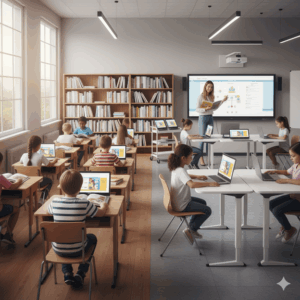
Human-to-human classrooms are quickly becoming a fusion of traditional human learning and digital learning. By combining digital, print, and AI-created resources, learners must fluidly traverse between the ecospheres of text and technology. Traditional literacy practices ground them in meaning-making across formats and modalities. Interpreting a poem, coding with a chatbot, or analyzing AI feedback requires the same cognitive strengths of complex and perceptive comprehension, expression, and synthesis. Education’s future is not about replacing print-based reading and writing with algorithms. It is about equipping learners with fused skills that enable them to negotiate meaning, no matter the instructional delivery method and ancillary resources. Thus, traditional literacy is what gives digital literacy its complex depth and ethical foundation. Literacy is no longer just an academic skill; in AI-mediated classrooms, it becomes a recognized form of human agency. By enabling learners to read and write with intention, educators safeguard critical and informed learners whose perceptive cognitive skills are rooted in digital and non-digital language, empowered with a deeper understanding to create meaning-making in the digital world.

Rebecca Blankenship
Rebecca J. Blankenship is an award-winning educator and researcher with over 25 years of teaching experience. Her current research examines the ecologies of meanings as a systems-based, hermeneutic approach to ethics in AI and gen-AI teaching and learning modalities. She is currently an Associate Professor in the College of Education at Florida Agricultural and Mechanical University.