Beyond Choice and Flexibility

From its early beginnings as mail-in correspondence courses and radio programs to its evolution to video courses, MOOCs, and internet-based programs, the concept of distance learning has been characterized as a democratizing educational modality. Distance learning inherently expands access by increasing flexible learning options adaptable to individual needs. However, as emerging technologies continue to evolve distance learning’s early and modern platforms, a more complex question about its future emerges:
Who actually benefits the most from distance learning, and who is potentially left behind?
 This question reveals a straightforward reality of distance learning: it is not inherently equitable. The impact of distance learning is not bound by or dependent on a specific modality to be impactful on student success, but rather on how inclusively and responsively it aligns with the contextual situations and learning needs to support a variety of learners.
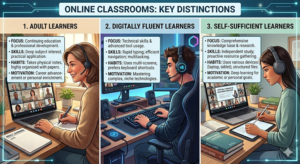
Certain distance learning models are inherently exclusive due to the nuances of individual human learning. For example, certain groups of learners are more likely to flourish in modern distance learning programs due to qualities such as digital fluency, self-regulation, and non-traditional status, especially among adult learners. For example, self-regulated learners—those with strong time management, goal-setting, and metacognitive skills—often excel. They can navigate asynchronous structures, manage deadlines independently, and persist through challenges without constant external prompting. Working adults and nontraditional students also stand to gain significantly. For learners balancing employment, caregiving, or other responsibilities, the flexibility of distance learning is not just convenient—it is essential. In many cases, it is the only viable pathway to continued education. Additionally, digitally fluent learners—those comfortable with online platforms, communication tools, and information navigation—experience fewer barriers. They spend less time figuring out how to learn and more time actually learning.
At the same time, other learners encounter structural challenges that distance learning, as commonly designed, does not adequately address. Students who require high levels of scaffolding—including many younger learners and those developing academic language—may struggle in environments that assume independence. Without intentional supports, these students can quickly fall behind. The digital divide remains a persistent issue. Access is not simply about having a device; it includes reliable internet, a quiet space to work, and ongoing technical support. When these conditions are absent, participation becomes inconsistent and inequitable.
Equally important are learners who rely on social presence and relational instruction. For students who benefit from real-time feedback, peer interaction, and a sense of community, poorly designed online environments can feel isolating and disengaging.
 It is tempting to interpret these patterns as evidence that distance learning works for some learners and not others. But this conclusion misses a critical point. The true differentiator is not the learner—it is the design. When distance learning environments are built primarily for content delivery, they tend to privilege independence, digital fluency, and existing academic confidence. In contrast, when they are intentionally designed for variability, they can support a much broader range of learners.
This means moving beyond static course shells and toward more responsive, inclusive approaches:
• Designing with multiple means of engagement, representation, and expression in mind
• Embedding opportunities for structured interaction and feedback
• Supporting the development of self-regulation skills, rather than assuming them
• Prioritizing human connection alongside efficiency
In other words, effective distance learning is not simply flexible—it is supported flexibility.
Reframing the conversation in this way shifts responsibility. Instead of asking which learners are best suited for distance learning, we begin to ask how distance learning can be better suited for learners. What would it look like to design systems where fewer students are left behind?
It would require institutions to invest in more than platforms—to invest in pedagogy, training, and student support structures. It would challenge educators to think not just about what content is delivered, but how learners experience that delivery.
Distance learning does not inevitably produce winners and losers. But without intentional design, it can reinforce existing inequities under the guise of innovation. The real question is not whether distance learning works. The real question is whether we are willing to design it in ways that allow far fewer learners to be left behind.

Rebecca Blankenship
About the Author
Rebecca J. Blankenship is an award-winning educator and researcher with over 25 years of teaching experience. Her current research examines the ecologies of meanings as a systems-based, hermeneutic approach to ethics in AI and gen-AI teaching and learning modalities. She is currently an Associate Professor in the College of Education at Florida Agricultural and Mechanical University.