
Superintelligence and the Ecologies of Learning

What happens when superintelligence (SI) becomes more than a tool learners use and instead becomes an influence woven throughout the environments in which they learn, develop, and interact?
This question challenges educational professionals to look beyond the surface of technological advancement and consider a deeper possibility: superintelligence could reshape the entire ecology of human learning.
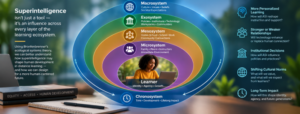 Urie Bronfenbrenner’s ecological systems theory provides a compelling and responsive framework for examining this future. Human development does not occur in isolation; it emerges through interactions among individuals, relationships, and time. As digital technologies become increasingly embedded within these systems, the implications for education extend far beyond the classroom.
Consider how a hypothetical superintelligent system might influence each layer of Bronfenbrenner’s framework.
Microsystem: Within the learner’s immediate environment, SI could personalize instruction, provide sophisticated, nuanced feedback, and support problem-solving. Yet it could also change how learners interact with instructors and peers.
Mesosystem: Connections among home, school, work, and community could become increasingly mediated by intelligent systems. These technologies might strengthen collaboration—or weaken relationships if human interaction becomes secondary to machine-generated responses.
Exosystem: Institutional decisions regarding instructional design, technology procurement, and student support could increasingly reflect SI recommendations, even when learners have little influence over them.
Macrosystem: Cultural beliefs about achievement, ethics, and human responsibility could shift dramatically. When machines appear capable of cognitively outperforming humans, societies must reconsider what education’s purpose is.
Chronosystem: Perhaps most significantly, the influence of superintelligence would unfold over time. Learners developing alongside increasingly capable systems may experience different relationships with agency, knowledge, and intellectual independence than previous generations.
Bronfenbrenner’s bioecological model emphasizes the interaction of Process, Person, Context, and Time (PPCT). Applied to distance learning, this framework raises a critical question: Under what conditions does superintelligent mediation strengthen human development, and when might it diminish the processes through which learning occurs?
The answer depends on more than a system’s capabilities. It depends on how learners engage with it, the relationships surrounding its use, the institutional structures governing it, and the developmental consequences that emerge over time.
Educators should begin evaluating emerging intelligent technologies through an ecological lens. Does implementation strengthen relationships? Preserve intellectual agency? Support independent judgment? Respect developmental needs? Produce meaningful learning beyond immediate task completion?
Superintelligence’s future will not be determined solely by how logical our technologies become. It will also depend on how thoughtfully we integrate them into the environments that shape human development.
The challenge is not simply to educate linearly within an age of superintelligence, but to ensure that the ecosystems in which we learn continue to support our capacity to subsist external to technological interventions.

Rebecca Blankenship
Dr. Rebecca J. Blankenship is a Professor and Director of TESOL programs in the Elementary Education Department at Florida A&M University’s College of Education. Dr. Blankenship has over 16 years of public school teaching experience in Tennessee and Florida. She earned her Ph.D. from the University of South Florida in Second Language Acquisition and Instructional Technology (SLA/IT), emphasizing teaching English to Speakers of Other Languages (ESOL) and virtual/simulated professional development for pre-service teacher candidates. She was a member of the FAMU Inaugural Provost’s Digital Learning Initiative in 2017 and is currently a DLI Ambassador. She is also an Association of Teacher Educators (ATE) Clinical Educator Fellow and UDL Level 3, Application Certified. Dr. Blankenship holds two national teaching credentials from the Association of College and University Educators (ACUE) in Effective College Instruction (Advanced). She is also the recipient of the FAMU 2022 Senior Level Teaching Innovation Award and the United States Distance Learning Association 2021 Impact Award, 2022 Quality Research Award – Gold Level, 2023 Research in Higher Education Award – Gold Level and 2024 Research in Higher Education Award – Silver Level. She is also the 2023 Florida A&M University Advanced Teacher of the Year and has been nominated for the university’s prestigious Distinguished Research Award, Non-STEM. She is currently the co-editor of Research Highlights in Technology and Teacher Education (RHTTE) and is on the Society for Information Technology in Education (SITE) Executive Board. She also serves on the Advisory Board for the United States Distance Learning Association (USDLA). Dr. Blankenship’s research interests include the development of the digital self through the hermeneutic loop and Johari Window of Personal Awareness, microgenetic regression in digital learning spaces, the digital agency and literacy and development of pre-service teachers and university faculty using generative AI. Her current research examines the ecologies of meanings as a systems-based, hermeneutic approach to ethics in AI and gen-AI teaching and learning.