Creating Distance Learning that Works for Everyone

From its early beginnings as mail-in correspondence courses and radio programs to its evolution to video courses, MOOCs, and internet-based programs, the concept of distance learning has been characterized as a democratizing educational modality. Distance learning inherently expands access by increasing flexible learning options adaptable to individual needs. However, as emerging technologies continue to evolve distance learning’s early and modern platforms, a more complex question about its future emerges:
 Who actually benefits the most from distance learning, and who is potentially left behind?
This question reveals a straightforward reality of distance learning: it is not inherently equitable. The impact of distance learning is not bound by or dependent on a specific modality to be impactful on student success, but rather on how inclusively and responsively it aligns with the contextual situations and learning needs to support a variety of learners.
Certain distance learning models are inherently exclusive due to the nuances of individual human learning. For example, certain groups of learners are more likely to flourish in modern distance learning programs due to qualities such as digital fluency, self-regulation, and non-traditional status, especially among adult learners.
Under current models, certain groups of learners are more likely to thrive in distance learning environments. For example, self-regulated learners with existing, strong metacognitive and organizational skills who focus on goal-setting can more easily navigate asynchronous modalities. They are also capable of independently managing deadlines and persisting through actual or perceived challenges without constant monitoring or external motivation. Another intrinsically motivated group includes working adults and non-traditional learners. Balancing responsibilities such as caregiving, employment, and other commitments makes distance learning ideal for its convenience and flexibility. For non-traditional learners, while accessibility and convenience are essential, it may be the only feasible pathway for continued education. Learners who are digitally adept, i.e., highly confident functioning in online platforms and navigating other technologies, also experience fewer barriers in distance learning environments. They spend much less time understanding platforms and requirements and more time learning content.
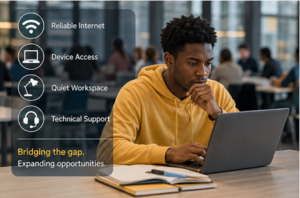
Conversely, other learners encounter challenges within common and current distance learning modalities. Learners who require significant support may struggle on platforms and in courses that require greater independence. These learners may quickly become isolated and fall behind, leading to higher failure rates. This digital gap is a persistent access issue in distance learning. Access has often been mistaken for just having a device, overlooking other necessities such as reliable internet, a dedicated workspace, and responsive technical support. In the absence of these qualifiers, successful participation is inconsistent and inequitable. Also, for these types of learners, social presence and relational instruction are highly important. Distance learning environments that lack real-time, personalized feedback, peer or classmate interaction, and a sense of online community can easily inhibit intended learning outcomes. Thus, intentional and thoughtful design is paramount for recognizing why distance learning works for some learners and not others, thereby mitigating accessibility issues. Hence, the true differentiating factor is not the learner but rather the design.
If a distance-learning course is designed primarily for content delivery, it tends to favor independent, digitally adept learners with established academic confidence. This type of design is very limiting in terms of learner profile. By contrast, if a course is purposefully designed around learner variability, learner access becomes much broader and dynamic, moving beyond static course shells to be more inclusive and responsive. Distance learning must not simply be flexible but rather support adaptability. This implicates multiple venues for engagement, expression, and representation. Human connection must be paramount alongside efficiency. Consequently, the conversation then shifts from which learners are best suited for distance learning to how distance learning can be structured to better suit a variety of learners. Without intentional, purposeful design, modern distance learning can reinforce lingering access inequalities in the name of innovation and progress. Accordingly, the question turns from whether distance education is still represents an ongoing, successful learning model for modern teaching and learning to whether educators are willing to rethink design to consider all learners.

Rebecca Blankenship
Rebecca J. Blankenship is an award-winning educator and researcher with over 25 years of teaching experience. Her current research examines the ecologies of meanings as a systems-based, hermeneutic approach to ethics in AI and gen-AI teaching and learning modalities. She is currently an Associate Professor in the College of Education at Florida Agricultural and Mechanical University.