
Moving Beyond Tradition to Reimagine the Future of Learning

Higher education is at a generational crossroads. Colleges and universities are swiftly investing in new technologies, expanding online offerings, incorporating AI, while simultaneously reexamining instructional practices. However, these developments proffer a more fundamental question: Are faculty actually preparing students for the world they are entering, or are they continuing to educate them for the world that existed when many of our institutional structures were established?
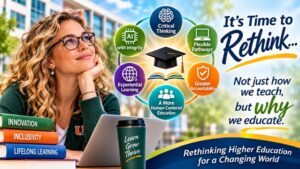 Higher education has mostly functioned within relatively predictable frameworks. Academic calendars, credit hours, degree requirements, and traditional classroom environments have shaped how institutions define learning. While these structures have provided consistency, that consistency should not be confused with relevance. The realities of a contemporary society require that these institutions reconsider not simply how education is delivered, but what is modern higher education’s purpose and relevance moving forward.
The Question Is Bigger Than Technology
Without a doubt, technology has categorically changed traditional teaching and learning modalities. Online learning, digital collaboration, adaptive platforms, and AI have expanded access to and dissemination of knowledge. That being said, adopting new technology does not automatically translate to educational innovation.
An institution can implement sophisticated technology while still maintaining outdated instructional practices. A course can be delivered entirely online and still replicate the limitations of a traditional lecture. Similarly, heuristically incorporating AI into assignments and assessments does not necessarily produce deeper learning or stronger intellectual development.
The real challenge is to move beyond technology as a replacement for existing practices and begin considering technology as a means for rethinking those practices. The question should not simply be whether students can access information more efficiently, but whether they can interpret, evaluate, question, and meaningfully apply what they learn.
Redefining What It Means to Learn
Traditional higher education must place greater emphasis on intellectual development rather than just the linear accumulation of content. Information is increasingly accessible, but the ability to make sense of that information remains fundamentally human.
Students must develop the capacity to think critically, recognize assumptions, examine competing perspectives, make informed decisions, and accept responsibility for their conclusions. These abilities cannot be measured exclusively through course completion, examination scores, or the number of credits accumulated.
The implementation of AI makes this distinction especially important. As machines become increasingly capable of producing human-like responses, analyzing information, and completing complex tasks, educators must become more intentional about preserving the intellectual processes that make learning meaningful.
Faculty should not measure educational progress by how effectively students can use technology to produce an answer. Rather, they should consider whether students understand the answer, can defend their reasoning, recognize its limitations, and apply their knowledge beyond the immediate assignment.
Rethinking the Institution, Not Just the Classroom
The responsibility for transforming higher education cannot rest solely with individual faculty members. Institutional structures must intentionally evolve as well.
Colleges and universities should reconsider whether traditional scheduling, rigid program requirements, and outdated measures of faculty productivity adequately support contemporary learners. Students are navigating professional responsibilities, family commitments, changing workforce expectations, and increasingly complex social environments. Educational institutions must recognize these realities without compromising academic expectations.
Adaptability should not mean lowering standards. Rather, it should mean creating more responsive pathways through which students can demonstrate knowledge, develop competencies, and achieve meaningful outcomes.
Likewise, institutional success should not be determined exclusively by enrollment, retention, graduation rates, or technological investments. These measures matter, but they tell only part of the story. Institutions must also examine the quality of learning, the development of professional judgment, the relevance of academic programs, and the extent to which graduates are prepared to contribute meaningfully to society.
The Human Dimension Must Remain Central
Perhaps the greatest risk in rethinking higher education is allowing efficiency to become more important than human development.
Education is inherently relational. Faculty do more than teach and mentor. They challenge assumptions, provide intellectual guidance, establish expectations, and create opportunities for students to develop confidence in their own thinking. Technology can support these relationships, but it cannot independently assume the responsibility for mentoring, professional judgment, or meaningful human engagement.
This becomes especially important as AI continues to evolve towards super intelligence. The future of higher education should not be framed as a competition between human intelligence and AI. Instead, institutions should consider how emerging technologies can support human capacity without displacing intellectual responsibility.
A Different Vision for Higher Education
Rethinking modern higher education requires more than updating curriculum and traditional practices. It requires a willingness to question assumptions that have remained largely unchallenged.
Colleges and universities must reconsider what represents meaningful learning, how academic achievement is demonstrated, why educational structures exist, and what responsibilities institutions have to the individuals and communities they serve.
The future university should be technologically capable, intellectually demanding, institutionally responsive, and fundamentally human-centered.
Ultimately, the question is not whether higher education can adapt to a changing world. It must. The more important question is whether institutions are willing to rethink what they have historically defined as education.

Rebecca Blankenship
Rebecca J. Blankenship is an award-winning educator and researcher with over 25 years of teaching experience. Her current research examines the ecologies of meanings as a systems-based, hermeneutic approach to ethics in AI and gen-AI teaching and learning modalities. She is currently an Associate Professor in the College of Education at Florida Agricultural and Mechanical University.