
A Year of Insight, Innovation, and Intention

True Leadership is Progress with Purpose
Over the past 12 months, the USDLA blog has served as a reflective space for the distance learning and broader educational communities to explore not only the rapid changes in technology but also the deeper questions facing education systems as they navigate those changes. USDLA’s blog has traced a clear evolution in how distance learning leaders, educators, and policymakers are thinking about technology, human learning, and institutional responsibility. What began as urgent conversations about artificial intelligence evolved into more nuanced considerations of leadership readiness, policy alignment, and long-term futures for distance and digital learning.
Rather than focusing on novelty, this year’s dialogue centered on the more pressing question of How do we prepare learning systems for sustained, ethical, and more human-centered transformation?
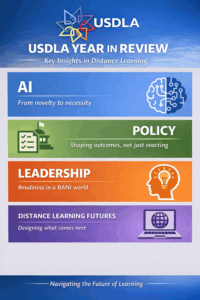
AI: Moving Beyond the Heuristic Moment
“The AI conversation has shifted from novelty to necessity—and from tools to trust.”
Over the past year, AI has emerged as a catalyst in reshaping how humans work, learn, and make decisions. Early conversations explored what AI can do; later discussions increasingly focused on what it should do and how it should be used responsibly.
AI was a dominant presence throughout the year, but USDLA’s conversations consistently resisted hype-driven narratives. Instead, posts emphasized the importance of intentional adoption, thoughtful integration, and a clear understanding of AI’s role in traditional human learning. As the year progressed, the focus shifted from experimentation to integration, asking not what AI can do, but what it should be used for in the service of learning outcomes and learner agency.
Across higher education, workforce development, vocational training, and global learning contexts, AI was framed as a catalytic tool to augment, not replace, human judgment in praxis and institutional readiness.
Key themes began to emerge and included:
• Moving beyond reactive adoption toward intentional, purpose-driven use of AI
• Recognizing AI as a cognitive partner rather than a replacement for human judgment
• Examining productivity, microlearning, accessibility, and sector-specific applications (including higher education, trade and vocational education, and global learning contexts)
• Addressing cognitive tension and disorienting dilemmas that arise as institutions reconcile human learning with machine-supported processes
Across these discussions, AI was framed less as a disruption and more as a test of institutional clarity, revealing where goals, values, and commitments to effective and sustainable practices are well-defined.
Policy: Navigating Complexity, Compliance, and Consequence
“Policy does not follow innovation—it shapes who benefits from it.”
Policy-focused reflections underscored the growing complexity of the regulatory environment surrounding distance learning and AI. Rather than positioning policy as a constraint, the blog emphasized policy literacy as a leadership skill.
Recurring policy considerations included:
• Federal and state reform efforts affecting distance education and workforce preparation
• Accessibility requirements and AI’s dual role as both barrier and enabler
• Gainful employment, certification pathways, and interdisciplinary credentialing
• The global policy landscape shaping AI, microlearning, and online education
Policy-oriented posts underscored the growing gap between technological capability and regulatory readiness. Rather than offering prescriptive answers, the blog emphasized the importance of policy literacy—helping educators and leaders understand how decisions are made, where authority resides, and how emerging regulations affect distance learning ecosystems. Taken together, these posts positioned policy not as a constraint, but as a strategic lever, one that requires proactive engagement rather than reactive compliance.
Leadership: Readiness in a BANI Environment
“Leadership readiness—not technological readiness—remains the limiting factor.”
Leadership was embedded and not treated as a separate topic this year. In an environment characterized by brittleness, anxiety, nonlinearity, and incomprehensibility (BANI), traditional leadership models were and will continue to be repeatedly challenged. Posts explored difficult conversations, psychological safety, adaptive leadership, and the widening gap between technological change and leadership preparedness.
USDLA’s blog characterized leadership as:
• Sense-making amid uncertainty
• Curiosity over certainty
• Dialogue over directive control
• Capacity-building over crisis response
Leadership emerged as a unifying thread across nearly every topic. As learning environments became more complex, leadership was increasingly framed in terms of sense-making, adaptability, and trust, rather than authority.
Leadership-focused reflections emphasized:
• The challenge of leading amid brittleness, anxiety, nonlinearity, and incomprehensibility (BANI conditions)
• Shifting from directive leadership to curiosity-driven and dialogic approaches
• Navigating difficult conversations, speaking truth within teams, and fostering psychological safety
• Ensuring leadership capacity keeps pace with technological change, not lagging behind it
Rather than positioning leaders as experts with answers, the year’s discourse consistently portrayed effective leadership as the ability to ask better questions, hold uncertainty, and guide institutions through transition without losing sight of human learning.
The Future of Distance Learning: Mindful Design
“The future of distance learning will not be defined by tools, but by values.”
Looking ahead, the blog consistently framed the future of distance learning as a design challenge, not a prediction exercise. Rather than forecasting a single outcome, posts emphasized the choices institutions make now about pedagogy, access, and learning design. The future of distance learning is not about abandoning foundational practices but about re-anchoring them in new contexts. Looking forward, USDLA’s blog framed the future of distance learning as a design challenge not merely a technological one. Posts explored how learning environments are evolving from static, content-driven models toward flexible, learner-centered, and technology-rich ecosystems.
Future-facing themes included:
• Reimagining classrooms from chalkboards to chatbots without abandoning foundational pedagogy
• Balancing innovation with inclusion, accessibility, and equity
• Moving from disruption narratives toward preparation and capacity-building
• Designing learning systems that remain human, relational, and meaningful in digital-first contexts
Rather than predicting a singular future, the blog emphasized that the future of distance learning will be shaped by the intentional choices made now in curriculum design, policy engagement, leadership development, and the ethical use of technology.
Looking Forward: USDLA’s Role
“In a year defined by acceleration, USDLA continued to lead with intention.”
Taken together, this year’s reflections reinforce USDLA’s role as a trusted convener and thought leader in distance learning. The blog did not offer quick answers. Instead, it created space for deeper inquiry, supporting leaders, educators, and policymakers as they navigate complexity with purpose.
As USDLA looks ahead, the focus remains clear:
• Supporting thoughtful AI integration
• Advancing policy understanding and engagement
• Strengthening leadership capacity
• Shaping a future for distance learning that is ethical, inclusive, and learner-centered

Rebecca Blankenship
Rebecca J. Blankenship is an award-winning educator and researcher with over 25 years of teaching experience. Her current research examines the ecologies of meanings as a systems-based, hermeneutic approach to ethics in AI and gen-AI teaching and learning modalities. She is currently an Associate Professor in the College of Education at Florida Agricultural and Mechanical University.